Virgilio Guidi and Zoran Mušič: “Painting Between Light and Darkness” exhibition in Riva del Garda
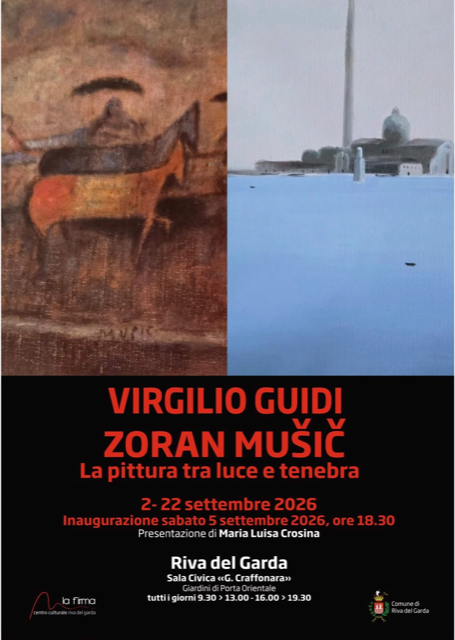
The Virgilio Guidi and Zoran Mušič exhibition opens on Saturday, 5 September 2026, at 6.30 p.m. at the “G. Craffonara” Civic Hall in Riva del Garda. Held at the Giardini di Porta Orientale, it will remain open until 22 September.
The Virgilio Guidi and Zoran Mušič exhibition opens on Saturday, 5 September 2026, at 6.30 p.m. at the “G. Craffonara” Civic Hall in Riva del Garda, at the Giardini di Porta Orientale. Entitled “Painting Between Light and Darkness”, the exhibition will be presented by Maria Luisa Crosina and will remain open until 22 September.
The exhibition brings together works by Virgilio Guidi and Zoran Mušič, two artists connected with Venice and with a pictorial investigation capable of moving through luminous dimensions as well as the more painful areas of human experience.
Guidi was born in Rome in 1891 and died in Venice in 1984. His studio overlooked St Mark’s Basin, where he observed for long periods the lagoon light reflected on the water. After leaving the Academy, he devoted himself to studying the masters of the past and took part in the leading group exhibitions of the period, including the Venice Biennales. He was among the representatives of Valori plastici and the Italian Novecento, before later moving towards the Spatialist movement. In 1935 he began teaching at the Academy of Fine Arts in Bologna, where he remained until 1944.
From 1946 onwards, he developed a substantial graphic practice, producing cycles devoted to “Visits”, “Seascapes” and “Figures in Space”. His research gradually moved away from figurative art, progressing from “meridian” light to “spatial” and “cosmic” light, and ultimately to the cycles “Ancient Sky”, “Anguishes”, “Judgements”, “Turmoils”, “The Prisoner” and “Man and the Sky”.
Zoran Mušič was born in Boccavizza in 1909 and died in Venice in 2005. He is remembered for his landscapes with horses and for Venetian views enveloped in monochrome atmospheres. In 1944, the Gestapo arrested him because of his links with members of the Slovenian resistance and deported him first to the Risiera di San Sabba and then to Dachau.
From the 1970s onwards, he translated the cycle “We Are Not the Last” into painting. It addressed the horror of the Shoah and was based on drawings made and concealed during his deportation. In his final years, his work also focused on interiors, cathedrals, portraits of his wife Ida Cadorin Barbarigo and self-portraits, created with a few essential strokes and a palette dominated by white, black, earth tones and red.