Riva del Garda: Guidi and Mušič exhibition at the Civica Crattonara
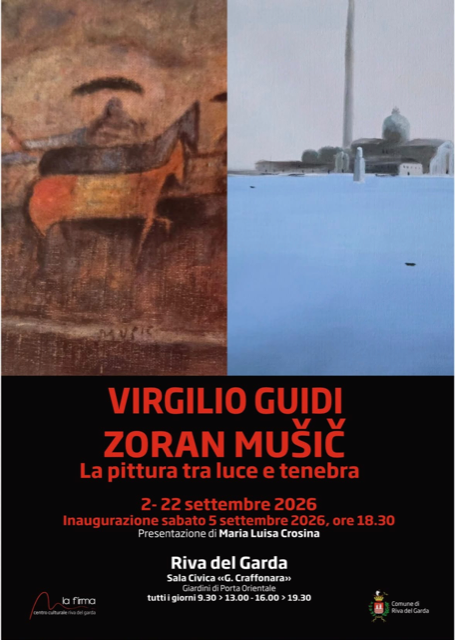
Riva del Garda, Virgilio Guidi and Zoran Mušič: the Civica Crattonara exhibition explores light and darkness.
Riva del Garda, on the northern shore of Lake Garda, is hosting a new exhibition devoted to Virgilio Guidi and Zoran Mušič. “La Pittura tra luce e tenebra” will be held at the “G. Crattonara” Civic Hall in the Giardini di Porta Orientale. The opening is scheduled for Saturday 5 September at 6.30 pm, with a presentation by Professor MariaLuisa Crosina. The exhibition places two leading figures of twentieth-century art in dialogue, united by their focus on Venice and their ability to translate emotions, contrasts and suspended visions between brightness and darkness onto canvas.
Virgilio Guidi was born in Rome in 1891 and died in Venice in 1984. For many years he worked from a studio overlooking St Mark’s Basin, observing the lagoon light reflected on the water. After leaving the Academy, he deepened his study of the old masters, from Giotto and Piero della Francesca to Correggio, Chardin, Courbet, Cézanne and Matisse.
Guidi was a constant presence in the main collective exhibitions of his time, especially the Venice Biennales. He also joined different artistic experiences, becoming one of the representatives of Valori plastici, the Italian Novecento and later the Spatialist Movement founded by Lucio Fontana.
In 1935 he accepted a teaching post at the Academy of Fine Arts in Bologna, where he remained until 1944. Two years earlier he had also begun writing poetry; his collection Spazi dell’esistenza was not published until 1959.
From 1946, an important phase of his graphic and pictorial work began, structured around major cycles devoted to the same subject and composition: from the “Visite” to the “Marine” and the “Figure nello spazio”. During this development he gradually moved away from figurative art. His light was first described as “meridiana”, then as “spaziale” in Venice and finally as “cosmica”. These works were followed by the “Cielo antico”, “Angosce”, “Giudizi” and “Tumulti” cycles, marked by an increasingly informal language. He then arrived at “Prigioniera”, also influenced by pop art. The image was reduced to a few essential signs, while numerous critical and theoretical writings accompanied his artistic and human journey. His final significant cycle was “L’uomo e il cielo”.
Zoran Mušič was born in Boccavizza in 1909 and died in Venice in 2005. As a child, he experienced life as a refugee in Styria. His paintings delicately portrayed landscapes inhabited by horses of different colours: in grasslands, along paths or on barges. These images became small, self-contained stories, crossed by both melancholy and lightness.
In Venice he met Ida Cadorin Barbarigo, his wife and inspirational muse. His personal story was also marked by his arrest by the Gestapo in 1944 because of his friendships with members of the Slovenian resistance. He was deported first to the Risiera di San Sabba and then to Dachau.
After returning to Venice in 1949, he created the celebrated “Stanza di Zurigo”, commissioned by sisters Charlotte and Nelly Dornacher to decorate the tavern of their villa in Zollikon. It was a true “total work of art”: alongside frescoes on plaster, he used linen and jute canvas and also designed the decorative motifs embroidered on the curtains and tablecloth. The work fell into ruin, but was restored through the efforts of his brother-in-law Paolo Cadorin and was displayed at the Venice ’18 exhibitions and in Gorizia/Nova Gorica, European Capital of Culture in 2025.
Only from the 1970s was he able to give shape to the prophetic cycle Non siamo gli ultimi, devoted to the horror of the Holocaust. The works derived from drawings he had made secretly at the time in order to survive; they later became an artistic denunciation of the universal tragedy of the extermination camps, represented through piles of dead or emaciated bodies awaiting death.
In the following years Mušič focused on more intimate paintings: Venetian interiors and exteriors of cathedrals enveloped in monochrome mist. During this phase, despite the difficulties connected with advanced age, he seemed to find a different relationship with the present.
Among his late works are the series of portraits dedicated to his wife Ida and the self-portraits: shadow-like figures marked by time, emerging from the darkness in a few essential strokes, in white, black and earth tones and the vivid red of the woman’s hair.